
Under optimum Nitrogen (N) fertilizer rate with best-split application time is an abiotic menace resulting in massive yield losses to global food security and malt barley and other major staple crops' quality. To harvest the highest grain yield with good quality, the optimal N-rate must coincide with the ideal split application timing, and variety is essential. Finding out how nitrogen application rates (50, 70, 90, and 110 kg ha-1) and split timing (Treatment 1 = full dose at sowing, Treatment 2 = half at sowing and a half at mid-tillering, and Treatment 3; = 1/4 at sowing, 1/2 at mid-tillering, and 1/4 at anthesis) affected the yield, physiological, and agro-physiological efficiency of various malt barley varieties during the main cropping season of 2022 and 2023 was the primary objective of this study. With an acceptable range of quality criteria (thousand seed weight of 35-45 g and hectoliter weight of 48-62 kg ha⁻1), the yield increased significantly from 2889.00 to 6611.10 kg ha⁻1. The IBONE174/03 variety had an appropriate amount of thousand-grain weight (49.82 g) compared to the EH1847 variety. Malt brewers are encouraged to adopt the IBONE 174/03 variety to suit their needs because it provides an ideal grain yield, a tolerable thousand-grain weight, and an acceptable hector litter weight. Optimizing malt quality, productivity, and physiological and agro-physiological efficiency requires using a 110 kg ha-1 N rate and one fourth at sowing, half at mid-tillering, and one fourth at anthesis application time.
| Published in | Science Discovery (Volume 14, Issue 4) |
| DOI | 10.11648/j.sd.20261404.22 |
| Page(s) | 261-271 |
| Creative Commons |
This is an Open Access article, distributed under the terms of the Creative Commons Attribution 4.0 International License (http://creativecommons.org/licenses/by/4.0/), which permits unrestricted use, distribution and reproduction in any medium or format, provided the original work is properly cited. |
| Copyright |
Copyright © The Author(s), 2026. Published by Science Publishing Group |
N-application Time, Nitrogen Fertilization, Hector Litter Weight, Physiological Efficiency, Agro-physiological Efficiency
Year | Physical Properties | Chemical properties | ||||||||
|---|---|---|---|---|---|---|---|---|---|---|
Sand | Clay | Silt | Textural Class | pH | OC | TN | Ava. P | Ex. K | CEC | |
% | % | mg kg-1 | Cmol kg + kg-1 | |||||||
2022 | 52.4 | 36.7 | 10.9 | Sandy Clay | 5.9 | 1.4 | 0.13 | 7.9 | 119 | 15.3 |
2023 | 51.8 | 37.6 | 10.6 | Sandy Clay | 6.1 | 1.6 | 0.14 | 8.8 | 121 | 16.7 |
Treatments | GY | TKW | HLW |
|---|---|---|---|
NR1T1 | 2889.00e | 46d | 57.21de |
NR2T1 | 3420.10de | 46.04d | 57.07de |
NR3T1 | 3774.30cd | 47.41cd | 57.80ce |
NR4T1 | 3225.70de | 48.65cd | 59.00be |
NR1T2 | 3302.10de | 46.53d | 57.00e |
NR2T2 | 4396.00c | 49.16cd | 59.67be |
NR3T2 | 3396.00de | 52.65bc | 59.33be |
NR4T2 | 5534.70b | 56.70b | 60.00bd |
NR1T3 | 3392.40de | 49.63cd | 57.02de |
N2T3 | 3680.6d | 56.22b | 60.23bc |
NR3T3 | 5468.70b | 58.08ab | 61.11b |
NR4T3 | 6611.10a | 62.27a | 68.83a |
LSD | 673.07 | 6.0264 | 2.4788 |
EMS | 373233.7 | 20.264949 | 5.0175167 |
CV | 14.9340 | 8.722176 | 3.763945 |
SOV | PE | GY | AgPE | TSW | HLW |
|---|---|---|---|---|---|
Time | NS | *** | NS | *** | *** |
Variety | *** | NS | *** | ** | NS |
N rate | NS | *** | NS | *** | *** |
TxV | * | NS | ** | NS | NS |
TxNr | NS | *** | * | ** | *** |
VxNr | NS | NS | NS | NS | NS |
TxVxNr | NS | NS | NS | NS | NS |
CV | 13.64 | 14.9340 | 13.70 | 8.722176 | 3.763945 |
Parameters | |
|---|---|
Variety (V) | TSW |
IBONE 174/03 | 49.82b |
EH 1847 | 53.40a |
LSD | 3.0836 |
EMS | 42.886594 |
CV | 12.68858 |
AACC | American Association of Cereal Chemists |
ANOVA | Analysis of Variance |
CEC | Cation‑Exchange Capacity |
DAP | Diammonium Phosphate |
EQSA | Ethiopian Quality Standard Authority |
FAO | Food And Agriculture Organization |
GAC | Grain Analysis Computer |
HLW | Hectoliter Weight |
LSD | Least Significant Difference |
OC | Organic Carbon |
RCBD | Randomized Complete Block Design |
TN | Total Nitrogen |
| [1] | Tricase, C., Amicarelli, V., Lamonaca, E., & Rana, R. L. (2018). Economic analysis of the barley market and related uses. Grasses as food and feed, 10. |
| [2] | Mulatu, B., & Grando, S. (2006,). Barley research and development in Ethiopia. In Proceedings of the 2nd National Barley Research and Development Review Workshop (pp. 28-30). |
| [3] | Hu, Y., Barmeier, G., & Schmidhalter, U. (2021). Genetic Variation in Grain Yield and Quality Traits of Spring Malting Barley. Agronomy, 11(6), 1177. |
| [4] | Geloso, V., Hinton, M., & Kufenko, V. (2017). The equally “bad” French and English farmers of Quebec: New TFP measures from the 1831 census. Historical Methods: A Journal of Quantitative and Interdisciplinary History, 50(3), 170-189. |
| [5] | Fox, G. P. (2010). Chemical Composition in Barley Grains and Malt Quality In Zhang G, Li C, editors. Genetics and Improvement of Barley Malt Quality. |
| [6] | Agegnehu, G., Liben, M., Molla, A., Feyissa, A., Bekele, A., & Getaneh, F. (2011). Research achievements in soil fertility management in relation to barley in Ethiopia. Barley research and development in Ethiopia, 137. |
| [7] | Molina-Cano, J. L., Francesch, M., Perez-Vendrell, A. M., Ramo, T., Voltas, J., & Brufau, J. J. J. O. C. S. (1997). Genetic and environmental variation in malting and feed quality of barley. Journal of Cereal Science, 25(1), 37-47. |
| [8] | CSA (Central Statistical Agency), Federal Democratic republic of Ethiopia central Statistical agency: Agricultural Sample Survey 2020/2021 (2013 E. C.). Report on Area and Production of Major Crops (Private Peasant Holdings, Meher Season) Statistical Bulletin 584, Federal Democratic Republic of Ethiopia, Addis Ababa, Ethiopia. |
| [9] | Akar, T., Avci, M., Dusunceli, F., & Mejía, D. (2004). Barley: Post-harvest operations. |
| [10] | Yesmin, S., Akhtar, M., & Hossain, B. (2014). Yield and Seed quality of barley (Hordeum vulgare L.) as affected by variety, nitrogen level, and harvesting time. International Journal of Agriculture and Crop Sciences, 7(5), 262. |
| [11] | Cochrane, M. P., & Duffus, C. M. (1983). Endosperm cell number in cultivars of barley differing in grain weight. Annals of Applied Biology, 102(1), 177-181. |
| [12] | Da Moraes, L. B. D., Freo, J. D., Biduski, B., Elias, M. C., & Gutkoski, L. C. (2013). Effects of rate, time, and splitting of nitrogen fertilization on the technological quality of wheat. Journal of Food Science and Engineering, 3(1), 9. |
| [13] | Leghari, S. J., Wahocho, N. A., Laghari, G. M., HafeezLaghari, A., MustafaBhabhan, G., HussainTalpur, K.,. & Lashari, A. A. (2016). Role of nitrogen for plant growth and development: A review. Advances in Environmental Biology, 10(9), 209-219. |
| [14] | Hirel, B., Tétu, T., Lea, P. J., & Dubois, F. (2011). Improving nitrogen use efficiency in crops for sustainable agriculture. Sustainability, 3(9), 1452-1485. Hirel, B., Tétu, T., Lea, P. J., & Dubois, F. (2011). Improving nitrogen use efficiency in crops for sustainable agriculture. Sustainability, 3(9), 1452-1485. |
| [15] | Mohammed, H., & Getachew, L. (2003). An overview of malt barley production and marketing in Arsi. In Proceedings of the workshop on constraints and prospects of malt barley, production, supply, and marketing organized by Asella Malt Factory and industrial projects service (pp. 1-25). |
| [16] | Endale, L. (2019). Effects of rate and time of nitrogen fertilizer application on yield, quality and nitrogen use efficiency of malt barley varieties (Hordeum distichon L.) AT ssonaworana woreda, central highland of Ethiopia. |
| [17] | Ashenafi Ali, Teklu Erkossa, Kiflu Gudeta, Wuletawu Abera, Ephrem Mesfin et al., 2024. Reference soil group’s map of Ethiopia based on legacy data and machine learning-technique: EthioSoilGrids 1.0. SOIL, 10, 189-209. |
| [18] | Walkley, A., Black, I., 1934. An examination of Degtjareff method for determining soil organic matter and a proposed modification of the chromic acid titration method. Soil Sci. 37, 29-37. |
| [19] | Bremner, J. M. (1960). Determination of nitrogen in soil by the Kjeldahl method. The Journal of Agricultural Science, 55(1), 11-33. |
| [20] | Rayment, G. E., & Lyons, D. J. (2011). Soil chemical methods: Australasia (Vol. 3). CSIRO publishing. |
| [21] | Nelson, D. A., & Sommers, L. (1983). Total carbon, organic carbon, and organic matter. Methods of soil analysis: Part 2 chemical and microbiological properties, 9, 539-579. |
| [22] | Olsen, S. R., Cole, C. V., Watanabe, F. S., Dean, L. A., 1954. Estimation of available phosphorus in soils by extraction with sodium carbonate. USDA Circular 939, 1-19. |
| [23] | Chapman, H. D., 1965. Cation exchange capacity by ammonium saturation. In: Black, C. A., Ensminger, L. E., Clark, F. E. (Eds.), Method of Soil Analysis. ASA, Madison, pp. 891-901. |
| [24] | AACC. (1993). Approved methods of the American Association of Cereal Chemists (AACC): Methods. St. Paul^ Minnesota Minnesota: AACC. |
| [25] | Motsara, M. R., & Roy, R. N. (2008). Guide to laboratory establishment for plant nutrient analysis (19): Food and Agriculture Organization of the United Nations Rome. FAO Viale delle Terme di Caracalla, 153. |
| [26] | Fageria, N. K., & Baligar, V. C. (2005). Enhancing nitrogen use efficiency in crop plants. Advances in agronomy, 88, 97-185. |
| [27] | Gomez, K. A., & Gomez, A. A. (1984). Statistical procedures for agricultural research. John Wiley & sons. |
| [28] | Jones, B. J. J., 2001. Laboratory Guides for Conducting Soil Tests and Plant Analysis. CRC Press, London, p. 363. |
| [29] | Tekalign, M., Haque, I., 1991. Phosphorus status of some Ethiopian soils. III: evaluation of soil test methods for available phosphorus. Trop. Agric. 68, 51-56. |
| [30] | Landon, J. R., 1991. Booker Tropical Soil Manual: a Handbook for Soil Survey and Agricultural Land Evaluation in the Tropics and Subtropics. Longman Scientific and Technical, Essex, New York, p. 474. OR John Wiley & Sons Inc., New York. |
| [31] | Gauer, L. E., Grant, C. A., Bailey, L. D., & Gehl, D. T. (1992). Effects of nitrogen fertilization on grain protein content, nitrogen uptake, and nitrogen use efficiency of six spring wheat (Triticum aestivum L.) cultivars, in relation to estimated moisture supply. Canadian Journal of Plant Science, 72(1), 235-241. |
| [32] | Ali, E. A. (2010). Grain yield and nitrogen use efficiency of pearl millet as affected by plant density, nitrogen rate, and splitting in sandy soil. American-Eurasian Journal of Agricultural and Environmental Science, 7(3), 327-335. |
| [33] | Ellen, J., & Spiertz, J. H. J. (1980). Effects of rate and timing of nitrogen dressings on grain yield formation of winter wheat (T. aestivum L.). Fertilizer Research, 1(3), 177-190. |
| [34] | Ashenafi, M., Lemma, E., & Tena, W. (2023). International Journal of Current Research and Academic Review. Int. J. Curr. Res. Aca. Rev, 11(3), 11-25. |
| [35] | Bekele, S., Yoseph, T., & Ayalew, T. (2020). Growth, protein content, yield, and yield components of malt barley (Hordeum vulgare L.) varieties in response to seeding rate at Sinana District, Southeast Ethiopia. International Journal of Applied Agricultural Sciences, 6(4), 61-71. |
| [36] | EQSA (Ethiopia Quality Standards Authority). 2006. Malting barley specification. Addis Ababa, Ethiopia. |
| [37] | Terefe, D., Desalegn, T., & Ashagre, H. (2018). Effect of nitrogen fertilizer levels on grain yield and quality of malt barley (Hordeum vulgare L.) varieties at Wolmera District, Central Highland of Ethiopia. International Journal of Research Studies in Agricultural Sciences, 4(4), 29-43. |
| [38] | Gezahegn, B., & Kefale, D. (2016). Effect of nitrogen fertilizer level on grain yield and quality of malt barley (Hordeum vulgare L.) varieties in Malga Woreda, southern Ethiopia. Food Science and Quality Management, 52(6), 8-16. |
| [39] | Rick, G., Ian, M., Nick, M., & Neroli, G. (2014). Western Australian malting barley varietal recommendations. Journal of Food Sciences, 2, 11-14. |
| [40] | Haile, D., Nigussie, D., & Ayana, A. (2012). Nitrogen use efficiency of bread wheat: Effect of nitrogen rate and time of application. Journal of soil science and plant nutrition, 12(3), 389-410. |
| [41] | Tana, T., Dalga, D., & Sharma, J. J. (2015). Effect of weed management methods and nitrogen fertilizer rates on grain yield and nitrogen use efficiency of bread wheat (Triticum aestivum L.) in southern Ethiopia. East African Journal of Sciences, 9(1), 15-30. |
| [42] | Belete, F., Dechassa, N., Molla, A., & Tana, T. (2018). Effect of nitrogen fertilizer rates on grain yield and nitrogen uptake and use efficiency of bread wheat (Triticum aestivum L.) varieties on the Vertisols of central highlands of Ethiopia. Agriculture & Food Security, 7(1), 78. |
APA Style
Ashenafi, M., Lemma, E., Tena, W. (2026). Grain Quality, Yield, and Physiological Efficiency of Malt Barley Varieties Under Diverse Nitrogen Amounts and Split - Utilization Timings in Ethiopia’s Central Highlands. Science Discovery, 14(4), 261-271. https://doi.org/10.11648/j.sd.20261404.22
ACS Style
Ashenafi, M.; Lemma, E.; Tena, W. Grain Quality, Yield, and Physiological Efficiency of Malt Barley Varieties Under Diverse Nitrogen Amounts and Split - Utilization Timings in Ethiopia’s Central Highlands. Sci. Discov. 2026, 14(4), 261-271. doi: 10.11648/j.sd.20261404.22
@article{10.11648/j.sd.20261404.22,
  author = {Mitiku Ashenafi and Endale Lemma and Wondwosen Tena},
  title = {Grain Quality, Yield, and Physiological Efficiency of Malt Barley Varieties Under Diverse Nitrogen Amounts and Split - Utilization Timings in Ethiopia’s Central Highlands},
  journal = {Science Discovery},
  volume = {14},
  number = {4},
  pages = {261-271},
  doi = {10.11648/j.sd.20261404.22},
  url = {https://doi.org/10.11648/j.sd.20261404.22},
  eprint = {https://article.sciencepublishinggroup.com/pdf/10.11648.j.sd.20261404.22},
  abstract = {Under optimum Nitrogen (N) fertilizer rate with best-split application time is an abiotic menace resulting in massive yield losses to global food security and malt barley and other major staple crops' quality. To harvest the highest grain yield with good quality, the optimal N-rate must coincide with the ideal split application timing, and variety is essential. Finding out how nitrogen application rates (50, 70, 90, and 110 kg ha-1) and split timing (Treatment 1 = full dose at sowing, Treatment 2 = half at sowing and a half at mid-tillering, and Treatment 3; = 1/4 at sowing, 1/2 at mid-tillering, and 1/4 at anthesis) affected the yield, physiological, and agro-physiological efficiency of various malt barley varieties during the main cropping season of 2022 and 2023 was the primary objective of this study. With an acceptable range of quality criteria (thousand seed weight of 35-45 g and hectoliter weight of 48-62 kg ha⁻1), the yield increased significantly from 2889.00 to 6611.10 kg ha⁻1. The IBONE174/03 variety had an appropriate amount of thousand-grain weight (49.82 g) compared to the EH1847 variety. Malt brewers are encouraged to adopt the IBONE 174/03 variety to suit their needs because it provides an ideal grain yield, a tolerable thousand-grain weight, and an acceptable hector litter weight. Optimizing malt quality, productivity, and physiological and agro-physiological efficiency requires using a 110 kg ha-1 N rate and one fourth at sowing, half at mid-tillering, and one fourth at anthesis application time.},
 year = {2026}
}
TY  - JOUR
T1  - Grain Quality, Yield, and Physiological Efficiency of Malt Barley Varieties Under Diverse Nitrogen Amounts and Split - Utilization Timings in Ethiopia’s Central Highlands
AU  - Mitiku Ashenafi
AU  - Endale Lemma
AU  - Wondwosen Tena
Y1  - 2026/07/08
PY  - 2026
N1  - https://doi.org/10.11648/j.sd.20261404.22
DO  - 10.11648/j.sd.20261404.22
T2  - Science Discovery
JF  - Science Discovery
JO  - Science Discovery
SP  - 261
EP  - 271
PB  - Science Publishing Group
SN  - 2331-0650
UR  - https://doi.org/10.11648/j.sd.20261404.22
AB  - Under optimum Nitrogen (N) fertilizer rate with best-split application time is an abiotic menace resulting in massive yield losses to global food security and malt barley and other major staple crops' quality. To harvest the highest grain yield with good quality, the optimal N-rate must coincide with the ideal split application timing, and variety is essential. Finding out how nitrogen application rates (50, 70, 90, and 110 kg ha-1) and split timing (Treatment 1 = full dose at sowing, Treatment 2 = half at sowing and a half at mid-tillering, and Treatment 3; = 1/4 at sowing, 1/2 at mid-tillering, and 1/4 at anthesis) affected the yield, physiological, and agro-physiological efficiency of various malt barley varieties during the main cropping season of 2022 and 2023 was the primary objective of this study. With an acceptable range of quality criteria (thousand seed weight of 35-45 g and hectoliter weight of 48-62 kg ha⁻1), the yield increased significantly from 2889.00 to 6611.10 kg ha⁻1. The IBONE174/03 variety had an appropriate amount of thousand-grain weight (49.82 g) compared to the EH1847 variety. Malt brewers are encouraged to adopt the IBONE 174/03 variety to suit their needs because it provides an ideal grain yield, a tolerable thousand-grain weight, and an acceptable hector litter weight. Optimizing malt quality, productivity, and physiological and agro-physiological efficiency requires using a 110 kg ha-1 N rate and one fourth at sowing, half at mid-tillering, and one fourth at anthesis application time.
VL  - 14
IS  - 4
ER  -
Department of Plant Science, Debre Berhan University, Debre Berhan, Ethiopia
Department of Crop Production,Ethiopian Agricultural Transformation Agency (ATA), Debre Berhan, Ethiopia
Department of Plant Biology and Biodiversity Management, Addis Ababa University, Addis Ababa, Ethiopia
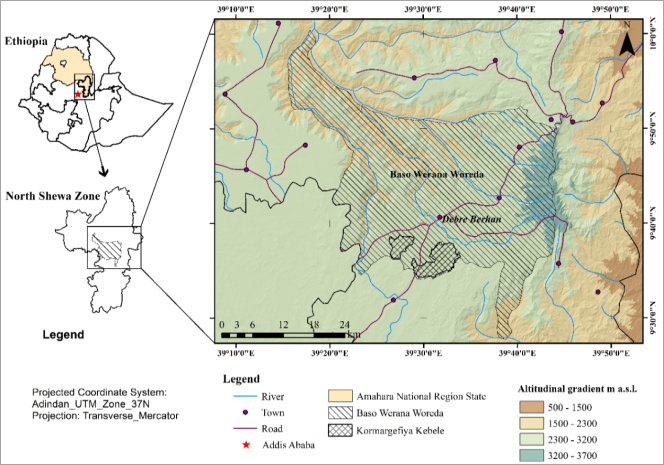
Figure 1. Map of the study area.
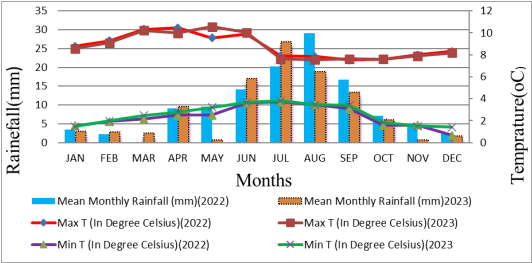
Figure 2. Monthly totals of rainfall (mm) alongside the peak (Max T) and trough (Min T) temperatures (°C) observed in 2022 and 2023. Source: National Metrological Data Agency.
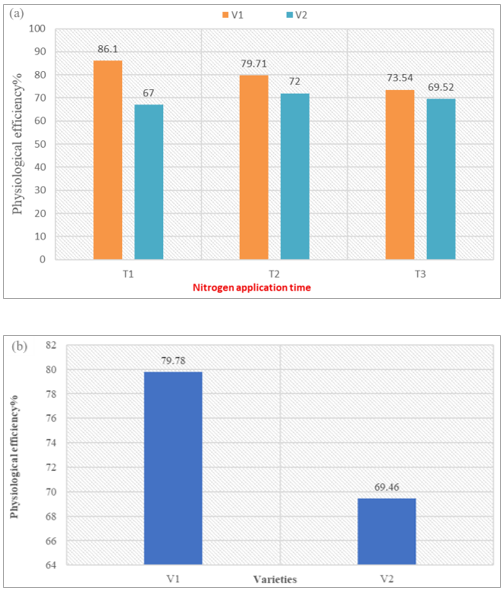
Figure 3. (a) Interaction between cultivar and the timing of split nitrogen application; (b) Main effect of cultivar, both influencing physiological efficiency.
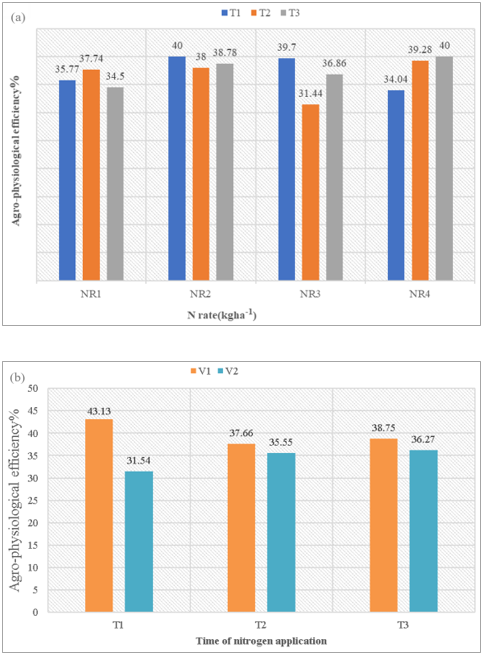
Figure 4. The interaction effect of N rate and time of nitrogen fertilizer split application (a) and varieties and time of nitrogen fertilizer application (b) on Agro - physiological efficiency.

Information



 Share This Article
 Twitter
 Linked In
 Facebook
 Copy
Copy Download