Abstract
Rural households in Ethiopia, specifically in Haramaya District, rely heavily on rain-fed subsistence agriculture for their livelihoods. This dependence exposes them to considerable risks associated with climate variability and long-term climatic changes. Strengthening the resilience of smallholder farmers therefore requires improving their ability to adopt and implement appropriate adaptation measures. This study examines the range of climate change adaptation practices employed by smallholder farmers in Haramaya District, located in the Oromia National Regional State, an area highly susceptible to climate-related challenges. The analysis draws on both primary and secondary data sources. Primary data were gathered from 189 randomly selected farm households using structured questionnaire, and were further enriched through Focus Group Discussions (FGDs) and Key Informant Interviews (KIIs). Secondary data was obtained from existing literature and institutional reports. The data were analyzed using descriptive statistical techniques alongside a multinomial probit model. The results indicate that smallholder farmers employ a variety of adaptation responses to cope with climate change. Among these, changing livestock type was the most commonly adopted strategy (22.75%), while changing the planting period was the least practiced (16.40%). Other adaptation strategies include soil and water conservation (22.22%), income diversification (20.63%), and cultivating drought-tolerant crop varieties (17.99%). Furthermore, the multinomial probit model results reveal that several factors significantly influence farmers’ adaptation decisions in the study area, such as: age, education level, size of the active labor force, frequency of extension contact, access to climate-related information, use of irrigation, livestock holdings, and access to credit. The findings underscore the importance of coordinated efforts of regional governments and Non-Governmental Organizations (NGOs) to enhance farmers’ adaptive capacity to climate change. Key areas of intervention include improving access to credit services, raising climate awareness and strengthening climate information dissemination systems, expanding and improving the effectiveness of agricultural extension services, promoting rural education, facilitating adoption of irrigation technologies, supporting livelihood diversification through livestock production, and investing in sustainable, long-term climate resilience initiatives.
|
Published in
|
Science Discovery (Volume 14, Issue 4)
|
|
DOI
|
10.11648/j.sd.20261404.21
|
|
Page(s)
|
249-260 |
|
Creative Commons
|

This is an Open Access article, distributed under the terms of the Creative Commons Attribution 4.0 International License (http://creativecommons.org/licenses/by/4.0/), which permits unrestricted use, distribution and reproduction in any medium or format, provided the original work is properly cited.
|
|
Copyright
|
Copyright © The Author(s), 2026. Published by Science Publishing Group
|
Keywords
Adaptation Strategies, Climate Change, Cross-sectional Study, Determinants, Ethiopia, Haramaya District,
Smallholder Farmers
1. Introduction
Agricultural production in Sub-Saharan Africa (SSA) is highly dependent on climatic conditions, particularly rainfall, which remains a critical determinant of crop productivity. The increasing variability and unpredictability in rainfall patterns, temperature regimes, and other climatic variables are intensifying globally due to climate change and associated environmental hazards
. Climate change is now widely recognized as a global phenomenon with profound impacts, disproportionately affecting rural livelihoods in developing countries, where resource-poor households face heightened exposure and limited adaptive capacity
| [2] | Asfaw, E., Suryabhagavan, K. V. And Argaw, M. 2018. Soil Salinity Modeling and Mapping Using Remote Sensing and GIS: The Case of Wonji Sugar Cane Irrigation Farm, Ethiopia. J. Saudi Soc. Agric. Sci. 17(3), 250–258.
https://doi.org/10.1016/j.jssas.2016.05.003 |
| [3] | Gupta, A. K., Negi, M., Nandy, S., Alatalo, J. M., Singh, V. and Pandey, R. 2019. Assessing the vulnerability of socio-environmental systems to climate change along an altitude gradient in the Indian Himalayas. Ecol. Indicat. 106, 105512.
https://doi.org/10.1016/j.ecolind.2019.105512 |
| [4] | Omerkhil, N., Chand, T., Valente, D., Alatalo, J. M. and Pandey, R. 2020. Climate change vulnerability and adaptation strategies for smallholder farmers in Yangi Qala district, Takhar, Afghanistan. Ecol. Indicat. 111, 105863.
https://doi.org/10.1016/j.ecolind.2019.105863 |
[2-4]
. Empirical studies
| [5] | Bandara, J. S. and Cai, Y. 2014. The impact of climate change on food crop productivity, food prices and food security in South Asia. Econ. Anal. Pol. 44(4), 451–465.
https://doi.org/10.1016/j.eap.2014.09.005 |
| [6] | Das, M., Das, A., Momin, S. and Pandey, R. 2020. Mapping the effect of climate change on community livelihood vulnerability in the Riparian region of gangatic plain, India. Ecol. Indicat. 11, 106815. https://doi.org/10.1016/j.ecolind.2020.106815 |
[5, 6]
consistently indicate that smallholder farm households in these regions are among the most vulnerable to climate-related risks and stresses.
In response to these challenges, farm households in SSA implement various climate change adaptation strategies, often through autonomous and experience-based decision-making processes. These adaptation responses are largely shaped by indigenous knowledge systems and traditional practices, with relatively low integration of modern technologies
| [7] | Leclere, D., Jayet, P. A. and de Noblet-Ducoudre, N. 2013. Farm-level autonomous adaptation of European agricultural supply to climate change. Ecol. Econ. 87, 1–14.
https://doi.org/10.1016/j.ecolecon.2012.11.010 |
| [8] | Khan, I., Lei, H., Shah, I. A., Ali, I., Khan, I., Muhammad, I., Javed, T. 2020. Farm households’ risk perception, attitude and adaptation strategies in dealing with climate change: promise and perils from rural Pakistan. Land Use Pol. 91, 104395.
https://doi.org/10.1016/j.landusepol.2019.104395 |
[7, 8]
. To reduce vulnerability and enhance resilience, farmers adopt a range of adaptive measures, including adjustments in planting dates, adoption of improved and drought-tolerant crop varieties, and crop diversification or substitution
| [9] | Stringer, L. C., Fraser, E. D., Harris, D., Lyon, C., Pereira, L., Ward, C. F., and Simelton, E. 2020. Adaptation and Development Pathways for Different Types of Farmers. Environ. Sci. Pol. 104, 174–189.
https://doi.org/10.1016/j.envsci.2019.10.007 |
| [10] | Ojo, T. O. and Baiyegunhi, L. J. S. 2020. Determinants of climate Change adaptation strategies and its impact on the net farm income of rice farmers in South-west Nigeria. Land Use Pol. 95, 103946.
https://doi.org/10.1016/j.landusepol.2019.04.007 |
[9, 10]
. Additional adaptation practices include modifying land allocation, crop marketing decisions, mulching, application of agrochemicals, integration of livestock production, mixed cropping systems, and the implementation of soil and water conservation techniques
| [2] | Asfaw, E., Suryabhagavan, K. V. And Argaw, M. 2018. Soil Salinity Modeling and Mapping Using Remote Sensing and GIS: The Case of Wonji Sugar Cane Irrigation Farm, Ethiopia. J. Saudi Soc. Agric. Sci. 17(3), 250–258.
https://doi.org/10.1016/j.jssas.2016.05.003 |
| [11] | Challinor, A. J., Watson, J., Lobell, D. B., Howden, S. M., Smith, D. R. and Chhetri, N. 2014. A meta-analysis of crop yield under climate change and adaptation. Nat. Clim. Change 4(4), 287. http://dx.doi.org/10.1038/nclimate2153 |
[2, 11]
.
Agriculture is a fundamental pillar of the economies of least developed countries, contributing substantially to the national Gross Domestic Product (GDP) and sustaining the livelihoods of a large portion of the population. Smallholder farmers, who are the backbone of agricultural production, depend directly or indirectly on farming for income and food security. Ethiopia is one of the countries, where agriculture remains the primary source of economic activity. Smallholder farmers are central to the national economy, although their productivity potential is often underexploited. These farmers typically manage small landholdings, averaging less than 0.9 hectares per household, cultivating primarily subsistence crops alongside one or two cash crops, and relying predominantly on family labor
| [12] | FAO (Food and Agricultural Organization of United Nations). 2015. The State of the World’s Land and Water Resources for Food and Agriculture. Managing systems at risk. Rome, FAO and London, Earthscan. |
[12]
.
According to the report of
| [13] | NBE (National Bank of Ethiopia). 2018. National bank of Ethiopia the share of agriculture on Ethiopian economy information. National bank of Ethiopia Annual Report 2017/18, Addis Ababa, Ethiopia. |
[13]
agriculture accounted for 34.9% of the Ethiopian economy during the 2017/18 fiscal year, contributing 16.5% to GDP growth. This growth was largely associated with a 4.7 percent increase in crop production of smallholder farmers compared to the preceding year. The expansion of smallholder agricultural production at the national level has a positive effect on overall economic growth and development, highlighting the sector as a foundational driver of the country’s Growth and Transformation Plan. However, smallholder agriculture faces significant challenges, particularly from climate change. In addition to socioeconomic constraints such as endemic poverty, conflicts, and limited access to capital and global markets, climate change represents one of the most complex and pressing environmental challenges confronting the sector today. Climate change lies at the heart of Ethiopia’s transformation agenda, as it is a key global concern and the country is highly vulnerable, with limited capacity for adaptation. Climate change is a natural phenomenon which influences agricultural production and negative effect on the social and economic activities and lead to food insecurity in particular
.
Adaptation strategies represent a critical mechanism for mitigating the impacts of climate change on smallholder farmers. Empirical studies indicate that implementing appropriate adaptation measures can substantially reduce both the vulnerability and severity of climate-induced risks. In the absence of adaptation, climate change exerts predominantly adverse effects on agricultural systems; however, the adoption of context-specific and effective adaptation interventions can markedly enhance resilience
| [15] | IFAD (International Fund for Agricultural Development). 2014. Annual Report, 2014: Platform for Agricultural Risk Management. |
[15]
. Therefore, promoting and implementing context-specific adaptation strategies is essential to sustain agricultural productivity, enhance livelihoods, and ensure food security in climate-sensitive regions.
Numerous studies have investigated climate-related issues in Ethiopia, particularly among farmers in the Nile Basin
| [16] | Hassan, R. and Nhemachena C. 2008. Determinants of African farmers strategies for adapting to climate change: multinomial choice analysis. African Journal of Agricultural and Resource Economics, 2(1): 83–104.
https://doi.org/10.22004/ag.econ.56969 |
| [17] | Yesuf, M., Di Falco, S., Deressa, T., Ringler C., and Kohlin G. 2008. The impact of climate change and adaptation on food production in low-income countries: Evidence from the Nile Basin, Ethiopia, EDRI. |
| [18] | Deressa, Temesgen T.; Hassan, Rashid; Ringler, Claudia. 2011. Perception of and adaptation to climate change by farmers in the Nile basin of Ethiopia. Journal of Agricultural Science 149(1): 23-31. https://doi.org/10.1017/S0021859610000687 |
[16-18]
. While these studies offer valuable insights for policy and intervention at the micro-level, especially for farmers in similar socio-economic and climatic contexts, a uniform approach is not ideal. The variations in agro-ecological zones necessitate that adaptation strategies be tailored to local contexts. Therefore, customizing adaptation strategies to local conditions is critical for effectively mitigating the adverse impacts of climate change on smallholder farmers.
Haramaya District, located in the Eastern Hararghe Zone, exhibits high exposure to climate change impacts, experiencing recurrent droughts and erratic rainfall patterns. To date, there is a notable gap in the literature regarding empirically grounded analyses of adaptation practices among smallholder agro pastoral households in this locality using household level survey data. Accordingly, this study aims to identify the key factors influencing farmers’ choices of adaptation strategies. Such strategies are essential for mitigating the adverse impacts of climate change, as they reduce the severity of climate-induced losses and contribute to the resilience and sustainability of agricultural productivity. Moreover, insights into farmers’ perceptions and adaptive responses to climate variability are indispensable for the development of effective, context specific adaptation policies and programs.
2. Research Methodology
2.1. Description of the Study Area
The research was carried out in the rural
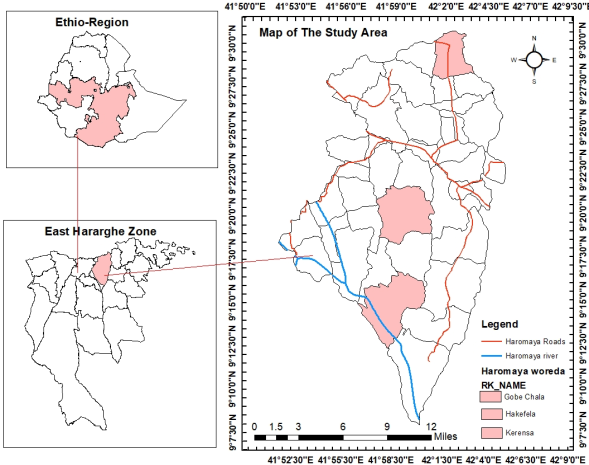
Kebeles of Haramaya District, situated in eastern Ethiopia, about 505 km from Addis Ababa, the country’s capital. The district shares its borders with Kurfa Chele in the south, Kersa in the west, Dire Dawa in the north, Kombolcha in the east, and the Harari Region in the southeast. Geographically, Haramaya is located at approximately 41°59'58" N latitude and 09°24'10" E longitude. Administratively, Haramaya District consists of 34 rural
Kebeles and 2 urban
Kebeles. The elevation of the district ranges between 1,900 and 2,450 meters above sea level. This altitudinal variation gives rise to three major agro-ecological zones: Dega (highland), Woinadega (midland), and Kola (lowland). Climatically, the district records an average annual rainfall of 74.1 mm and has a mean annual temperature of 16.9°C. The dry period, defined by monthly rainfall below 30 mm, typically spans from October to February. The principal rainy season (autumn rains) occurs from September to November, while the shorter spring rains are experienced between March and May
| [19] | HWADPFSO (Haramaya District Administration Disaster Preparedness and Food Security Office). 2015. Pre- and Post-harvest Assessment Report. |
[19]
.
Figure 1. Geographical Location of Haramaya District.
2.2. Sampling Technique and Sample Size
The research was carried out in Haramaya District, which comprises 34 rural Kebeles and two towns. To obtain a representative sample, a stratified random sampling technique was applied. In the first stage, all Kebeles were grouped into three agro-ecological zones: Dega (highland), Woinadega (midland), and Kola (lowland). Subsequently, one Kebele from each stratum was randomly selected, namely Gobe Chala (highland), Kerensa Sharif Kalid (midland), and Haqa Fila (lowland).
Following this, households within the selected
Kebeles were chosen at random from the official household lists. The allocation of sampled households was determined proportionally to the total number of households in each
Kebele:
Gobe Chala (800 households),
Haqa Fila (978 households), and
Kerensa Sharif Kalid (673 households). The overall sample size was computed using Yamane’s
| [20] | Yamane, T. 1967. Statistics, An Introductory Analysis (2nd ed.). New York: Harper and Row. |
[20]
formula with a 7% margin of error, yielding a total of 189 households. This sampling procedure enhanced the representativeness of the study by adequately capturing variations across the district’s agro-ecological zones.
Where: denotes the required sample size, represents the total number of households (population size), and indicates the desired level of precision. Applying this calculation to the total population of 2,451 households yielded a minimum sample size of 189 households.
Table 1. Distribution of sampled households across selected Kebeles.
Kebeles | Sample households | Sample size | Percentage |
Gobe Chala | 800 | 62 | 32.5% |
Haqa Fila | 978 | 75 | 40% |
Kerensa Sharif Kalid | 673 | 52 | 27.5% |
Total | 2451 | 189 | 100% |
2.3. Data Type and Methods of Data Collection
This study employed a mixed-methods research design, integrating both quantitative and qualitative data from primary and secondary data sources to examine smallholder farmers’ adaptation strategies to climate change in Haramaya District. The combined approach allowed for a holistic assessment of the implemented adaptation measures and the demographic, socio-economic, and institutional determinants shaping farmers’ adaptation decisions.
Primary data collection involved three complementary methods: household surveys, Focus Group Discussions (FGDs), and Key Informant Interviews (KIIs). A structured questionnaire was administered to 189 households, selected randomly to ensure representativeness, and was translated into Afan Oromo to facilitate accurate responses. FGDs were organized within each selected Kebele, with each group comprising eight participants reflecting diverse age cohorts, gender, and socio-economic status. The discussions focused on farmers’ perceptions of climate variability, including shifts in rainfall regimes, temperature anomalies, and the frequency of extreme weather events, as well as current coping mechanisms and adaptation practices. Additionally, KIIs were conducted with 16 stakeholders, including ten community-level key informants (five male and five female farmers), three Kebele-level Development Agents (DAs), and three district-level agricultural experts.
Secondary data were obtained from prior empirical research, official government reports, unpublished documents, and publications from regional, zonal, and district agricultural offices. The triangulation of multiple data sources strengthened the validity and reliability of the study’s findings and provided a nuanced understanding of the demographic, institutional, and socio-economic determinants shaping climate change adaptation strategies among smallholder farmers.
2.4. Analytical Methods
Data collected from both primary and secondary sources were analyzed through an integrated approach combining qualitative and quantitative methods. This mixed-method approach facilitated a thorough examination of smallholder farmers’ strategies for adapting to climate change, as well as the determinants influencing their adoption decisions.
Qualitative information derived from focus group discussions and key informant interviews was analyzed using thematic analysis. The data were systematically coded, organized into thematic categories, and interpreted to elucidate farmers’ perceptions of climate change, locally implemented adaptation practices, and the contextual factors that shape their selection of adaptation measures.
Quantitative data were analyzed using descriptive statistics alongside an econometric Multinomial Probit (MNP) model. Descriptive analyses—including means, percentages, and frequency distributions—summarized the socio-economic profiles of sampled households and identified prevalent adaptation strategies. The MNP model was applied to determine the key factors influencing farmers’ choices among alternative strategies aimed at mitigating the effects of climate change. By integrating descriptive statistics, econometric modeling, and qualitative insights, the study achieved a comprehensive understanding of both observable adaptation patterns and the socio-economic and institutional drivers underlying farmers’ adaptation decisions.
2.5. Multinomial Probit Model Specification
Smallholder farmers frequently adopt multiple adaptation strategies simultaneously to address the variety of risks and challenges associated with climate change, rather than depending on a single approach. Analytical tools commonly employed to model such multi-choice adaptation decisions include the multinomial logit (MNL) and multinomial probit (MNP) models. For instance, Nhemachena and Hassan
| [21] | Nhemachena, C. and R. Hassan, 2007. Micro-level analysis of farmers adaptation to climate change in Southern Africa. IFPRI Discussion Paper No. 00714. |
[21]
applied the multinomial probit model to explore the factors influencing farmers’ adaptation decisions in Southern Africa. Nevertheless, many studies on climate change adaptation overlook the potential interconnections among different strategies.
In response to climate-induced pressures, farm households often implement a combination of adaptation measures, enabling them to reduce climate-related risks and capitalize on the synergies between different practices. Farmers’ adaptation decisions are also path-dependent, implying that earlier responses to climatic shocks or environmental stressors can shape subsequent adaptation choices. As highlighted by
| [22] | Kassie, B. T., Hengsdijk, H., Rötter, R., Kahiluoto, H., Asseng, S. and Van Ittersum, M. 2013. Adapting to climate variability and change: experiences from cereal-based farming in the Central Rift and Kobo Valleys, Ethiopia. Environmental Management, 52(5), pp. 1115-1131.
https://doi.org/10.1007/s00267-013-0145-2 |
[22]
the simultaneous adoption of multiple strategies indicates that these decisions are interrelated, leading to potential correlations in the error terms across the adaptation equations. Ignoring such correlations and analyzing each strategy independently may yield biased or inefficient results. To address this, the present study utilizes a multinomial probit model to identify the factors influencing smallholder farmers’ choices of climate change adaptation strategies.
Following Lin
| [23] | Lin J. 1991. Education and innovation adoption in agriculture: evidence from hybrid rice in China. American Journal of Agricultural Economics, 73(3): 713-723.
https://doi.org/10.2307/1242823 |
[23]
, the multinomial probit model is specified with a single dependent variable, i.e., adaptation strategy, and five discrete outcomes:
(changing planting period),
(soil and water conservation practices),
(changing livestock type),
(income source diversification), and
(growing drought tolerant crops such that:
and
Where
;
represents a vector of explanatory variables;
and
are the corresponding parameter vectors; and
and
denote random error terms, which are assumed to follow a multivariate normal distribution with zero mean, unit variance and correlation matrix. Accordingly, the dependent variable in the empirical estimation of this study is the choice of adaptation decision(s) from a set of climate change adaptation measures identified. However, the selection of adaptation strategies is influenced by multiple socio-economic, demographic, and institutional factors. The model is also employed to explore the potential trade-offs and synergies among the strategies adopted by farmers. By estimating the influence of explanatory variables on each adaptation option simultaneously, the approach accounts for correlations among unobserved disturbances and captures the interdependencies between the various practices implemented by farmers
| [22] | Kassie, B. T., Hengsdijk, H., Rötter, R., Kahiluoto, H., Asseng, S. and Van Ittersum, M. 2013. Adapting to climate variability and change: experiences from cereal-based farming in the Central Rift and Kobo Valleys, Ethiopia. Environmental Management, 52(5), pp. 1115-1131.
https://doi.org/10.1007/s00267-013-0145-2 |
[22]
.
2.6. Definition of Variables and Working Hypothesis
Dependent variable: The dependent variable in this study represents the selection of climate change adaptation strategies most commonly employed by smallholder farmers in the research area. In accordance with the assumptions of the multinomial probit model, these choices are treated as mutually exclusive. The variable is categorical and encompasses the following adaptation options: adjusting planting periods, adopting soil and water conservation practices, changing livestock types, diversifying income sources, and cultivating drought-tolerant crops.
Explanatory variables: Based on insights from previous studies on climate change adaptation, a set of demographics, socio-economic, and institutional factors is proposed to influence smallholder farmers’ decisions in adopting specific adaptation strategies within the study area.
Table 2. Summary of Variables, Definition, and Measurement.
Variables | Type | Definition | Measurement |
Dependent variable | | | |
Adaptation strategies to climate change | Categorical | | |
Explanatory variables | | | |
Age | Continuous | Age of household head | Year |
Education level | Continuous | Education level of household head | Class completed |
Access to credit | Dummy | Access to credit | 1 if access; 0 otherwise |
Sex | Dummy | Sex of household head | 1 if access; 0 otherwise |
Distance to market | Continuous | Distance from home to the nearest market | kilometre |
Climate information | Dummy | Access to climate information | 1 if access; 0 otherwise |
Cultivated land size | Continuous | Cultivated land size | Hectare |
Household farm income | Continuous | Annual on-farm income | Birr |
Active labor size | Continuous | Household member whose age is between 15 and 65 | Number |
Livestock holding | Continuous | Total livestock holding | TLU |
Irrigation access | Dummy | Access to irrigation water | 1 if access; 0 otherwise |
Extension visits | Continuous | Extension visits | Number of visits |
3. Results and Discussion
This chapter presents the findings of the study on climate change adaptation strategies and farmers’ perceptions, based on data collected from 189 households, focus group discussions, and key informant interviews. The chapter is structured into two main sections: the first outlines the adaptation strategies employed by smallholder farmers in the study area, and the second presents the results of econometric analyses identifying the determinants of these strategies.
3.1. Households’ Adaptation Strategies to Climate Change
Smallholder farmers are particularly vulnerable to climate change, especially in developing regions where agriculture is predominantly rain-fed and highly sensitive to climatic variability. Key challenges affecting agricultural productivity include shifts in rainfall patterns, prolonged droughts, increasing temperatures, and soil degradation. In response, farmers act as proactive agents, adopting various strategies to sustain their livelihoods rather than passively confronting these environmental stresses. Examining these adaptation practices is essential for informing agricultural policy, promoting climate-resilient development, and designing interventions aligned with the realities of rural communities.
Farmers in the study area were surveyed regarding the measures they had implemented to cope with climate-related risks. The findings indicate that smallholder farmers are actively engaged in multiple adaptation practices to mitigate the impacts of climate change on their agricultural activities and livelihoods. A substantial proportion of respondents reported experiencing climate-related challenges in recent years and confirmed that they employ a combination of strategies to reduce associated risks.
Among the identified measures, changing livestock types was the most frequently adopted strategy, with 43 farmers (22.75%) switching to more resilient or drought-tolerant breeds. This reflects efforts to address declining availability of feed and water resources. Similarly, 42 farmers (22.22%) reported utilizing Soil and Water Conservation (SWC) techniques such as terracing, mulching, and water harvesting. These interventions indicate an understanding of the importance of preventing soil erosion, conserving moisture, and enhancing soil fertility—crucial factors for maintaining agricultural productivity under increasingly variable climatic conditions.
Additionally, 39 respondents (20.63%) diversified their income sources through off-farm employment, including small-scale businesses, reducing their reliance on climate-sensitive farming. Other commonly reported strategies included cultivating drought-tolerant crops (17.99%) and adjusting planting schedules (16.40%). Farmers highlighted that drought-resistant crops provide greater reliability under dry conditions and shorter growing seasons, whereas altering planting periods allows them to adapt to the increasingly unpredictable timing of rainfall, which has rendered traditional planting calendars less dependable.
Overall, these results demonstrate that smallholder farmers in the study area are highly responsive to climate-related risks. Their adaptation decisions are driven by both necessity and experiential knowledge, offering critical insights for the development of locally relevant support mechanisms and agricultural policies aimed at enhancing resilience to climate change.
Table 3. The widely used adaptation strategies to climate change by smallholder farmers.
Strategies | Frequency | Percentage |
Change livestock type | 43 | 22.75 |
Soil and water conservation | 42 | 22.22 |
Income source diversification | 39 | 20.63 |
Growing drought tolerant crops | 34 | 17.99 |
Changing planting period | 31 | 16.40 |
3.2. Econometric Model Results
3.2.1. Regression Diagnostics
Before estimating the multinomial probit model, it was essential to identify outliers and assess potential multicollinearity among the explanatory variables. Multicollinearity can substantially distort parameter estimates, as the simultaneous inclusion of highly correlated variables may either attenuate or exaggerate their individual effects. In such cases, the coefficients of interacting variables can provide guidance on whether one of the correlated variables should be omitted from the model (Kotari, 1990).
Accordingly, diagnostic tests were conducted prior to model estimation to ensure that the underlying assumptions of the model were met. The Variance Inflation Factor (VIF) was computed for all explanatory variables using SPSS version 20 to detect potential multicollinearity. All VIF values were found to be below the threshold of 10, indicating that multicollinearity is unlikely to compromise the reliability of the model estimates (
Table 4).
Table 4. Variance Inflation Factor (VIF) for continuous variable.
Continuous explanatory variable | VIF | TOL |
Education level | 1.80 | 0.554831 |
Extension visits | 1.51 | 0.664000 |
Household farm income | 1.33 | 0.753762 |
Active labor size | 1.31 | 0.765100 |
Cultivated land size | 1.19 | 0.843022 |
Age | 1.18 | 0.843921 |
Livestock holding | 1.10 | 0.910464 |
Distance to market | 1.09 | 0.917724 |
Mean VIF | 1.31 | |
In addition, interactions between dummy variables can contribute to multicollinearity. To assess this, contingency coefficients (CC) were computed from the survey data using SPSS version 20. The results presented in
Table 5 below indicated no strong associations among the discrete explanatory variables, as all coefficients were low (< 0.75).
Table 5. Contingency Coefficients (CC) for Dummy Variables.
Dummy explanatory variable | Contingency Coefficient (CC) |
Irrigation access | 0.196 |
Climate information | 0.180 |
Access to credit | 0.107 |
Sex | 0.043 |
3.3.2. Determinants of Farmers Choice of Adaptation Strategies to Climate Change
The multinomial probit model was utilized to assess the influence of explanatory variables on smallholder farmers’ selection of climate change adaptation strategies, with results summarized in
Table 6. The model’s overall fit was evaluated using the Log-Likelihood Ratio (LR) test, which produced a Wald chi² value of 423.21 and a probability value (Prob > chi²) of 0.00, indicating strong statistical significance and provides a strong fit to the data. The Pseudo R² of 0.73 suggests that approximately 73% of the variation in adaptation strategy choice is explained by the 12 variables included in the model, highlighting the model’s effectiveness in capturing key determinants of households’ adaptation decisions.
Cross-sectional data obtained from 189 households were used to examine the factors influencing the adoption of major adaptation strategies, including adjusting planting periods, implementing soil and water conservation measures, changing livestock types, diversifying income sources, and cultivating drought-tolerant crops. The findings reveal that the adoption of specific climate change adaptation strategies is influenced by a combination of demographic, socio-economic, and institutional factors. Of the twelve variables incorporated in the model, eight were statistically significant. These are age and education level of the household head, active labor size, frequency of formal extension services, access to climate information, irrigation access, livestock holding, credit access. The discussion below focuses solely on the variables that had significant effects on the choice of adaptation strategies.
Age of the household head: As shown in
Table 6, the age of the household head positively influenced the adoption of strategies such as adjusting planting periods, changing livestock types, and diversifying income sources, with significance levels of 5%, 5%, and 1%, respectively. This indicates that older household heads are more likely to adopt adaptation measures to mitigate the adverse effects of climate change, reflecting their accumulated experience and greater familiarity with environmental variability. The marginal effect results indicate that each additional year in the age of the household head increases the probability of adopting specific adaptation strategies—adjusting planting periods, changing livestock type, and diversifying income sources—by 0.2%, 0.15%, and 0.12%, respectively. These findings align with
| [21] | Nhemachena, C. and R. Hassan, 2007. Micro-level analysis of farmers adaptation to climate change in Southern Africa. IFPRI Discussion Paper No. 00714. |
[21]
who emphasize the importance of household head age in adaptation decision-making.
Educational level: The table below depicts that the household head’s education level was a significant factor influencing the adoption of changes in livestock type as an adaptation strategy to climate change, with significance at the 5% level. The positive association indicates that more educated farmers are more likely to adopt new livestock breeds with high drought resistance and other resilient traits, reflecting their greater understanding of the potential benefits of adaptation measures in coping with climate change and associated risks. The model results further indicate that each additional year of formal education increases the probability of changing livestock type as a climate change adaptation strategy by 1.5%, which is consistent with the findings of Hassan and Nhemachena
| [21] | Nhemachena, C. and R. Hassan, 2007. Micro-level analysis of farmers adaptation to climate change in Southern Africa. IFPRI Discussion Paper No. 00714. |
[21]
.
Active labor size: According to the model output, the number of active household members (aged 15–65) had a positive and statistically significant influence on both adjusting planting periods and diversifying income sources, each at the 5% probability level. This indicates that households with a larger labor force are better positioned to implement labor-intensive climate change adaptation strategies. Holding other factors constant, each additional active household member increases the probability of adopting specific adaptation measures to climate change, such as modifying planting periods by 3.2% and diversifying income sources by 4.6%.
Access to formal extension services: The model results indicate that households with access to extension services were more likely to adopt drought-tolerant crops as a climate change adaptation strategy, and it was found to be statistically significant at the 5% level (p < 0.05). Marginal effect results showed that each additional day of extension visits increases the probability of adopting drought-tolerant crops by 3.4%. This finding highlights the pivotal role of extension services in disseminating information on climate change impacts and facilitating the uptake of effective adaptation strategies. Strengthening extension systems and ensuring that extension agents are well-trained in locally relevant, context-specific adaptation practices is critical for enhancing smallholder resilience
| [21] | Nhemachena, C. and R. Hassan, 2007. Micro-level analysis of farmers adaptation to climate change in Southern Africa. IFPRI Discussion Paper No. 00714. |
| [24] | Alemneh, D. 2011. Proceedings of strengthening capacity for climate change adaptation in the agriculture sector in Ethiopia, 5–6 July 2010. Nazareth, Ethiopia.
https://www.fao.org/4/i2155e/i2155e00.pdf |
| [25] | Ifeanyi-Obi, C. C., Asiabaka, C. C., Matthews-Njoku, E., Nnadi, F. N., Agumagu, A. C., Adesope, O. M., Issa, F. O. and Nwakwasi, R. N., 2012. Effects of climate change on fluted pumpkin production and adaptaton measures used among farmers in rivers state. Journal of Agricultural Extension, 16(1). http://dx.doi.org/10.4314/jae.v16i1.6 |
[21, 24, 25]
.
Access to climate information: Access to timely and reliable climate information emerged as a critical factor shaping farmers’ adaptation decisions in the study area. Households that received regular climate updates were more likely to implement specific adaptation strategies, particularly changing livestock type and diversifying income sources, both of which were statistically significant at the 5% probability level (
Table 6). The marginal effect results further reveal that households with access to climate information were more likely to adopt changes in livestock type by 0.08% and more likely to diversify income sources by 0.2% compared to those without such climate information access, holding other variables constant. These results align with findings reported by Alemayehu and Bewket
| [26] | Alemayehu, A. and Bewket, W., 2017. Smallholder farmers’ coping and adaptation strategies to climate change and variability in the central highlands of Ethiopia. Local environment, 22(7), pp. 825-839.
https://doi.org/10.1080/13549839.2017.1290058 |
[26]
.
Access to information from the national meteorological agency played a crucial role in enhancing farmers’ ability to adopt suitable climate change adaptation strategies. Households receiving regular weather updates were better positioned to adjust crop choices, modify planting schedules, and plan agricultural activities in response to seasonal and inter-annual climate variability. This underscores the importance of complementing agricultural advice with reliable, locally relevant climate forecasts and extension support to strengthen the adaptive capacity and resilience of smallholder farmers.
Access to irrigation: The influence of irrigation on climate change adaptation strategies was found to be mixed. Specifically, access to irrigation was negatively associated with the adoption of Soil and Water Conservation (SWC) practices at the 10% significance level, suggesting that irrigated households were less inclined to implement SWC measures. Conversely, irrigation positively influenced the adoption of drought-tolerant crops, raising the probability of adoption by 12.7% relative to households without irrigation.
Irrigation enables smallholder farmers to offset moisture deficits, diversify cropping systems, and sustain agricultural productivity under variable climatic conditions. By ensuring a reliable water supply, irrigation allows households to cultivate consumable crops, enhance overall food security, and maintain agricultural production even amidst the challenges posed by climate change.
Table 6. Determinants of adaptation choice to climate change: Multinomial probit model.
Explanatory Variables | Changing planting period | Soil and water c onservation | Change livestock type | Income source diversification | Growing drought tolerant crops |
Coef. | P-Value | Coef. | P-Value | Coef. | P-Value | Coef. | P-Value | Coef. | P-Value |
Sex of the household head | -0.136 | 0.841 | -0.201 | 0.526 | 0.210 | 0.528 | -0.003 | 0.999 | 0.041 | 0.904 |
Age of the household head | 0.054 | 0.014** | 0.0188 | 0.366 | 0.041 | 0.036** | 0.059 | 0.005* | -0.030 | 0.183 |
Education level | -0.048 | 0.407 | -0.096 | 0.103 | 0.118 | 0.042** | -0.022 | 0.695 | 0.090 | 0.131 |
Active labor size | 0.337 | 0.019** | -0.069 | 0.610 | -0.219 | 0.107 | 0.288 | 0.042** | 0.209 | 0.121 |
Frequency of extension visit | 0.012 | 0.949 | 0.175 | 0.343 | -0.202 | 0.084 | 0.027 | 0.884 | 0.372 | 0.048** |
Access to credit | 0.629 | 0.308 | 0.887 | 0.112 | -1.00 | 0.084* | 0.114 | 0.839 | -0.436 | 0.424 |
Distance from market | -0.005 | 0.841 | 0.014 | 0.540 | 0.011 | 0.603 | -0.026 | 0.262 | -0.001 | 0.956 |
Cultivated land size | -0.341 | 0.534 | -0.229 | 0.644 | -0.375 | 0.444 | 0.605 | 0.233 | -0.477 | 0.361 |
Household farm income | 0.02 | 0.225 | -0.001 | 0.354 | 0.000 | 0.715 | 0.002 | 0.196 | 0.000 | 0.567 |
Livestock holding in TLU | -0.323 | 0.627 | 0.039 | 0.542 | 0.068 | 0.275 | -0.107 | 0.091* | 0.0137 | 0.833 |
Access to climate info | -0.136 | 0.373 | 0.124 | 0.710 | 0.682 | 0.047** | -0.806 | 0.021** | 0.235 | 0.490 |
Access to irrigation | -0.529 | 0.337 | -0.917 | 0.072* | 0.386 | 0.460 | 0.531 | 0.292 | 0.919 | 0.083* |
Constant | 0.721 | 0.45 | 0.069 | 0.941 | -1.29 | 0.157 | 1.23 | 0.191 | -0.102 | 0.917 |
Number of observations | 189 | | | | | | | | | |
Log likelihood | -32.33 | | | | | | | | | |
LR chi2 (19) | 423.21 | | | | | | | | | |
Prob > chi2 | 0.00 | | | | | | | | | |
Pseudo R2 | 0.73 | | | | | | | | | |
Post-estimation results, derived from marginal effects and predicted probabilities, indicate that the likelihood of households adopting specific climate change adaptation strategies was 16.69% for adjusting planting periods, 22.32% for implementing soil and water conservation practices, 15.25% for income source diversification, 28.92% for changing livestock types, and 16.82% for cultivating drought-tolerant crops.
Table 7. The probability of using different adaptation strategies to climate change.
Adaptation strategies | Likelihood |
Change livestock type | 28.92% |
Soil and water conservation practices | 22.32% |
Growing drought tolerant crops | 16.82% |
Changing planting period | 16.69% |
Diversification of their income sources | 15.25% |
4. Summary, Conclusion and Recommendations
4.1. Summary and Conclusion
Ethiopia remains highly vulnerable to climate change due to its heavy dependence on rain-fed agriculture, recurrent droughts, erratic rainfall patterns, and limited adaptive capacity at both household and community levels. These climate-related shocks disrupt cropping calendars, reduce agricultural productivity, and heighten the risk of crop and livestock failure, thereby undermining rural livelihoods and food security. Understanding the factors that influence farmers’ adaptation decisions is crucial for designing targeted interventions to enhance resilience. This study examines the determinants of farmers’ climate change adaptation strategies in the Haramaya District, Eastern Ethiopia. Cross-sectional data were collected from 189 randomly selected households across three rural Kebeles using a structured questionnaire. In addition, qualitative data were gathered through focus group discussions and key informant interviews. The collected data were analyzed using descriptive statistics and a multinomial probit model. Descriptive statistics provided an overview of farmers’ perceptions of climate change, and the range of adaptation measures employed. The multinomial probit model allowed for identification of the demographic, socio-economic, and institutional factors that significantly influence the adoption of specific adaptation strategies.
The descriptive analysis revealed that the most commonly employed adaptation strategy was changing livestock type, adopted by 43 households (22.75%). This was closely followed by soil and water conservation practices, implemented by 42 households (22.22%), and diversification of income sources, practiced by 39 households (20.63%). Cultivation of drought-tolerant crops was reported by 34 households (17.99%), while altering planting schedules was the least common adaptation strategy, adopted by 31 households (16.40%). These findings highlight that farmers are implementing diverse strategies to cope with the adverse impacts of climate change, with particular emphasis on enhancing livestock resilience and sustainably managing natural resources, while also exploring alternative livelihood sources.
Results from the multinomial probit model show that the age and education level of the household head, the size of the active labor force, frequency of extension visit, access to climate information, use of irrigation, credit access, and livestock holdings are significant determinants of adaptation choices. The model further estimates the predicted probabilities of adopting each strategy: adjusting planting periods (16.69%), implementing soil and water conservation measures (22.32%), diversifying income sources (15.25%), changing livestock type (28.92%), and cultivating drought-tolerant crops (16.82%). These results underscore that human capital, access to climate-related information, technology, and financial resources play critical roles in shaping farmers’ responses to climate change.
4.2. Recommendations
Several evidence-based recommendations are proposed for local policymakers and stakeholders in the district to enhance farmers’ resilience to climate change.
Policy interventions aimed at mitigating the adverse effects of climate change should focus on supporting farmers to intensify and effectively utilize existing adaptation strategies, such as cultivating drought-tolerant crop varieties, adjusting planting periods, implementing soil and water conservation measures, diversifying income sources, and changing livestock types. Strengthening institutional support, technical assistance, and access to necessary inputs will further enhance the sustainability and effectiveness of these adaptation measures.
Farmers’ perceptions of climate change strongly influence their adoption of adaptation strategies; however, a substantial number of households still lack sufficient awareness of changing climatic conditions and their potential impacts. Consequently, greater attention should be given to climate education and awareness-raising programs to facilitate informed decision-making at the household level. This can be achieved through improved extension services, farmer-to-farmer knowledge exchange, community discussions, and wider dissemination of climate information via media platforms. Supporting informal social networks and local knowledge-sharing forums will further enable farmers to select and implement appropriate adaptation measures. Additionally, promoting multiple channels for climate information—including radio, extension agents, local networks, and traditional leaders—and enhancing coordination among these sources will strengthen farmers’ capacity to respond effectively to climate risks.
Adaptation initiatives should be context-specific, taking into account local agro-ecological conditions and gender differences to ensure equitable participation and effectiveness. Gender-sensitive approaches are critical to addressing disparities in access to resources, information, and decision-making power, thereby increasing the likelihood of successful adoption of adaptation measures among smallholder farmers. Expanding adult education programs is also essential, as literate farmers are better equipped to interpret climate-related information and apply it to farming practices, improving their ability to select and implement appropriate adaptation strategies. Flexible learning systems and targeted capacity-building programs will support long-term resilience development.
Encouraging diversification of on-farm and off-farm income sources is another important strategy for enhancing household resilience. Higher income levels increase farmers’ purchasing power, enabling investment in critical inputs such as drought-tolerant seeds, irrigation systems, seedlings, and fertilizers. Ensuring the accessibility and affordability of these inputs, combined with promotion of alternative income-generating activities, will strengthen the ability of households to withstand climate shocks.
Targeted guidance is needed for farmers with different landholding sizes. Households with larger farms should be supported to adopt suitable adaptation measures through focused extension support, while those with smaller farms should receive guidance on efficient and intensified production practices to maximize limited resources. Modernizing livestock husbandry systems—from traditional to improved practices—can also reduce labor, time, and land constraints while enhancing productivity and resilience to climate variability.
Improving farmers’ access to affordable credit is vital to enable the adoption of various adaptation strategies, including drought-tolerant crops, adjusted planting periods, soil and water conservation, income diversification, and livestock management changes. Expanding the reach of formal credit institutions, offering reasonable interest rates, and promoting financial literacy will enhance households’ investment capacity and accelerate the uptake of climate-resilient practices.
Finally, further research is recommended to evaluate the impacts of climate change on the livelihoods of smallholder farmers, and assess the effectiveness of individual adaptation measures in reducing vulnerability to climate change. Such studies will provide evidence-based insights to inform the refinement and prioritization of future policy and development interventions.
Abbreviations
CC | Contingency Coefficients |
DAs | Development Agents |
FAO | Food and Agriculture Organization of the United Nations |
FGDs | Focus Group Discussions |
GDP | Gross Domestic Product |
HWADPFSO | Haramaya District Administration Disaster Preparedness and Food Security Office |
HWAEPA | Haramaya District Administration Environmental Protection Authority |
IPCC | Intergovernmental Panel on Climate Change |
KIIs | Key Informant Interviews |
MNP | Multinomial Probit |
NBE | National Bank of Ethiopia |
SSA | Sub-Saharan Africa |
SWC | Soil and Water Conservation |
TLU | Tropical Livestock Unit |
VIF | Variance Inflation Factor |
Author Contributions
Habtamu Abaynew: Conceptualization, Data curation, Formal Analysis, Investigation, Methodology, Software, Visualization, Writing – original draft, Writing – review & editing
Nasir Ahmed: Conceptualization, Data curation, Investigation, Writing – original draft
Ahmed Mohammed: Writing – review & editing
Adisu Beyene: Writing – review & editing
Conflicts of Interest
The authors declare no conflicts of interest.
References
| [1] |
IPCC (Intergovernmental Panel on Climate Change). 2014. Climate change, 2014: Impacts, Adaptation, and Vulnerability.
https://www.ipcc.ch/report/ar5/wg2/
|
| [2] |
Asfaw, E., Suryabhagavan, K. V. And Argaw, M. 2018. Soil Salinity Modeling and Mapping Using Remote Sensing and GIS: The Case of Wonji Sugar Cane Irrigation Farm, Ethiopia. J. Saudi Soc. Agric. Sci. 17(3), 250–258.
https://doi.org/10.1016/j.jssas.2016.05.003
|
| [3] |
Gupta, A. K., Negi, M., Nandy, S., Alatalo, J. M., Singh, V. and Pandey, R. 2019. Assessing the vulnerability of socio-environmental systems to climate change along an altitude gradient in the Indian Himalayas. Ecol. Indicat. 106, 105512.
https://doi.org/10.1016/j.ecolind.2019.105512
|
| [4] |
Omerkhil, N., Chand, T., Valente, D., Alatalo, J. M. and Pandey, R. 2020. Climate change vulnerability and adaptation strategies for smallholder farmers in Yangi Qala district, Takhar, Afghanistan. Ecol. Indicat. 111, 105863.
https://doi.org/10.1016/j.ecolind.2019.105863
|
| [5] |
Bandara, J. S. and Cai, Y. 2014. The impact of climate change on food crop productivity, food prices and food security in South Asia. Econ. Anal. Pol. 44(4), 451–465.
https://doi.org/10.1016/j.eap.2014.09.005
|
| [6] |
Das, M., Das, A., Momin, S. and Pandey, R. 2020. Mapping the effect of climate change on community livelihood vulnerability in the Riparian region of gangatic plain, India. Ecol. Indicat. 11, 106815.
https://doi.org/10.1016/j.ecolind.2020.106815
|
| [7] |
Leclere, D., Jayet, P. A. and de Noblet-Ducoudre, N. 2013. Farm-level autonomous adaptation of European agricultural supply to climate change. Ecol. Econ. 87, 1–14.
https://doi.org/10.1016/j.ecolecon.2012.11.010
|
| [8] |
Khan, I., Lei, H., Shah, I. A., Ali, I., Khan, I., Muhammad, I., Javed, T. 2020. Farm households’ risk perception, attitude and adaptation strategies in dealing with climate change: promise and perils from rural Pakistan. Land Use Pol. 91, 104395.
https://doi.org/10.1016/j.landusepol.2019.104395
|
| [9] |
Stringer, L. C., Fraser, E. D., Harris, D., Lyon, C., Pereira, L., Ward, C. F., and Simelton, E. 2020. Adaptation and Development Pathways for Different Types of Farmers. Environ. Sci. Pol. 104, 174–189.
https://doi.org/10.1016/j.envsci.2019.10.007
|
| [10] |
Ojo, T. O. and Baiyegunhi, L. J. S. 2020. Determinants of climate Change adaptation strategies and its impact on the net farm income of rice farmers in South-west Nigeria. Land Use Pol. 95, 103946.
https://doi.org/10.1016/j.landusepol.2019.04.007
|
| [11] |
Challinor, A. J., Watson, J., Lobell, D. B., Howden, S. M., Smith, D. R. and Chhetri, N. 2014. A meta-analysis of crop yield under climate change and adaptation. Nat. Clim. Change 4(4), 287.
http://dx.doi.org/10.1038/nclimate2153
|
| [12] |
FAO (Food and Agricultural Organization of United Nations). 2015. The State of the World’s Land and Water Resources for Food and Agriculture. Managing systems at risk. Rome, FAO and London, Earthscan.
|
| [13] |
NBE (National Bank of Ethiopia). 2018. National bank of Ethiopia the share of agriculture on Ethiopian economy information. National bank of Ethiopia Annual Report 2017/18, Addis Ababa, Ethiopia.
|
| [14] |
Ministry of Finance and Economic Development (MoFED). 2010. Growth and Transformation plan (2010/11-2014/15), Addis.
https://www.scribd.com/doc/227370847/Ethiopia-Growth-and-Transformation-Plan-2010-11-2014-15-Volume-I-Main-Text-by-Ministry-of-Finance-and-Economic-Development-November-2010
|
| [15] |
IFAD (International Fund for Agricultural Development). 2014. Annual Report, 2014: Platform for Agricultural Risk Management.
|
| [16] |
Hassan, R. and Nhemachena C. 2008. Determinants of African farmers strategies for adapting to climate change: multinomial choice analysis. African Journal of Agricultural and Resource Economics, 2(1): 83–104.
https://doi.org/10.22004/ag.econ.56969
|
| [17] |
Yesuf, M., Di Falco, S., Deressa, T., Ringler C., and Kohlin G. 2008. The impact of climate change and adaptation on food production in low-income countries: Evidence from the Nile Basin, Ethiopia, EDRI.
|
| [18] |
Deressa, Temesgen T.; Hassan, Rashid; Ringler, Claudia. 2011. Perception of and adaptation to climate change by farmers in the Nile basin of Ethiopia. Journal of Agricultural Science 149(1): 23-31.
https://doi.org/10.1017/S0021859610000687
|
| [19] |
HWADPFSO (Haramaya District Administration Disaster Preparedness and Food Security Office). 2015. Pre- and Post-harvest Assessment Report.
|
| [20] |
Yamane, T. 1967. Statistics, An Introductory Analysis (2nd ed.). New York: Harper and Row.
|
| [21] |
Nhemachena, C. and R. Hassan, 2007. Micro-level analysis of farmers adaptation to climate change in Southern Africa. IFPRI Discussion Paper No. 00714.
|
| [22] |
Kassie, B. T., Hengsdijk, H., Rötter, R., Kahiluoto, H., Asseng, S. and Van Ittersum, M. 2013. Adapting to climate variability and change: experiences from cereal-based farming in the Central Rift and Kobo Valleys, Ethiopia. Environmental Management, 52(5), pp. 1115-1131.
https://doi.org/10.1007/s00267-013-0145-2
|
| [23] |
Lin J. 1991. Education and innovation adoption in agriculture: evidence from hybrid rice in China. American Journal of Agricultural Economics, 73(3): 713-723.
https://doi.org/10.2307/1242823
|
| [24] |
Alemneh, D. 2011. Proceedings of strengthening capacity for climate change adaptation in the agriculture sector in Ethiopia, 5–6 July 2010. Nazareth, Ethiopia.
https://www.fao.org/4/i2155e/i2155e00.pdf
|
| [25] |
Ifeanyi-Obi, C. C., Asiabaka, C. C., Matthews-Njoku, E., Nnadi, F. N., Agumagu, A. C., Adesope, O. M., Issa, F. O. and Nwakwasi, R. N., 2012. Effects of climate change on fluted pumpkin production and adaptaton measures used among farmers in rivers state. Journal of Agricultural Extension, 16(1).
http://dx.doi.org/10.4314/jae.v16i1.6
|
| [26] |
Alemayehu, A. and Bewket, W., 2017. Smallholder farmers’ coping and adaptation strategies to climate change and variability in the central highlands of Ethiopia. Local environment, 22(7), pp. 825-839.
https://doi.org/10.1080/13549839.2017.1290058
|
Cite This Article
-
APA Style
Abaynew, H., Ahmed, N., Mohammed, A., Beyene, A. (2026). Responding to a Changing Climate: A Cross-sectional Study of the Determinants of Smallholder Farmers’ Adaptation Strategies in Eastern Ethiopia. Science Discovery, 14(4), 249-260. https://doi.org/10.11648/j.sd.20261404.21
 Copy
|
Copy
|
 Download
ACS Style
Abaynew, H.; Ahmed, N.; Mohammed, A.; Beyene, A. Responding to a Changing Climate: A Cross-sectional Study of the Determinants of Smallholder Farmers’ Adaptation Strategies in Eastern Ethiopia. Sci. Discov. 2026, 14(4), 249-260. doi: 10.11648/j.sd.20261404.21
Copy
|
Download
AMA Style
Abaynew H, Ahmed N, Mohammed A, Beyene A. Responding to a Changing Climate: A Cross-sectional Study of the Determinants of Smallholder Farmers’ Adaptation Strategies in Eastern Ethiopia. Sci Discov. 2026;14(4):249-260. doi: 10.11648/j.sd.20261404.21
Copy
|
Download
-
@article{10.11648/j.sd.20261404.21,
  author = {Habtamu Abaynew and Nasir Ahmed and Ahmed Mohammed and Adisu Beyene},
  title = {Responding to a Changing Climate: A Cross-sectional Study of the Determinants of Smallholder Farmers’ Adaptation Strategies in Eastern Ethiopia},
  journal = {Science Discovery},
  volume = {14},
  number = {4},
  pages = {249-260},
  doi = {10.11648/j.sd.20261404.21},
  url = {https://doi.org/10.11648/j.sd.20261404.21},
  eprint = {https://article.sciencepublishinggroup.com/pdf/10.11648.j.sd.20261404.21},
  abstract = {Rural households in Ethiopia, specifically in Haramaya District, rely heavily on rain-fed subsistence agriculture for their livelihoods. This dependence exposes them to considerable risks associated with climate variability and long-term climatic changes. Strengthening the resilience of smallholder farmers therefore requires improving their ability to adopt and implement appropriate adaptation measures. This study examines the range of climate change adaptation practices employed by smallholder farmers in Haramaya District, located in the Oromia National Regional State, an area highly susceptible to climate-related challenges. The analysis draws on both primary and secondary data sources. Primary data were gathered from 189 randomly selected farm households using structured questionnaire, and were further enriched through Focus Group Discussions (FGDs) and Key Informant Interviews (KIIs). Secondary data was obtained from existing literature and institutional reports. The data were analyzed using descriptive statistical techniques alongside a multinomial probit model. The results indicate that smallholder farmers employ a variety of adaptation responses to cope with climate change. Among these, changing livestock type was the most commonly adopted strategy (22.75%), while changing the planting period was the least practiced (16.40%). Other adaptation strategies include soil and water conservation (22.22%), income diversification (20.63%), and cultivating drought-tolerant crop varieties (17.99%). Furthermore, the multinomial probit model results reveal that several factors significantly influence farmers’ adaptation decisions in the study area, such as: age, education level, size of the active labor force, frequency of extension contact, access to climate-related information, use of irrigation, livestock holdings, and access to credit. The findings underscore the importance of coordinated efforts of regional governments and Non-Governmental Organizations (NGOs) to enhance farmers’ adaptive capacity to climate change. Key areas of intervention include improving access to credit services, raising climate awareness and strengthening climate information dissemination systems, expanding and improving the effectiveness of agricultural extension services, promoting rural education, facilitating adoption of irrigation technologies, supporting livelihood diversification through livestock production, and investing in sustainable, long-term climate resilience initiatives.},
 year = {2026}
}
Copy
|
Download
-
TY  - JOUR
T1  - Responding to a Changing Climate: A Cross-sectional Study of the Determinants of Smallholder Farmers’ Adaptation Strategies in Eastern Ethiopia
AU  - Habtamu Abaynew
AU  - Nasir Ahmed
AU  - Ahmed Mohammed
AU  - Adisu Beyene
Y1  - 2026/06/29
PY  - 2026
N1  - https://doi.org/10.11648/j.sd.20261404.21
DO  - 10.11648/j.sd.20261404.21
T2  - Science Discovery
JF  - Science Discovery
JO  - Science Discovery
SP  - 249
EP  - 260
PB  - Science Publishing Group
SN  - 2331-0650
UR  - https://doi.org/10.11648/j.sd.20261404.21
AB  - Rural households in Ethiopia, specifically in Haramaya District, rely heavily on rain-fed subsistence agriculture for their livelihoods. This dependence exposes them to considerable risks associated with climate variability and long-term climatic changes. Strengthening the resilience of smallholder farmers therefore requires improving their ability to adopt and implement appropriate adaptation measures. This study examines the range of climate change adaptation practices employed by smallholder farmers in Haramaya District, located in the Oromia National Regional State, an area highly susceptible to climate-related challenges. The analysis draws on both primary and secondary data sources. Primary data were gathered from 189 randomly selected farm households using structured questionnaire, and were further enriched through Focus Group Discussions (FGDs) and Key Informant Interviews (KIIs). Secondary data was obtained from existing literature and institutional reports. The data were analyzed using descriptive statistical techniques alongside a multinomial probit model. The results indicate that smallholder farmers employ a variety of adaptation responses to cope with climate change. Among these, changing livestock type was the most commonly adopted strategy (22.75%), while changing the planting period was the least practiced (16.40%). Other adaptation strategies include soil and water conservation (22.22%), income diversification (20.63%), and cultivating drought-tolerant crop varieties (17.99%). Furthermore, the multinomial probit model results reveal that several factors significantly influence farmers’ adaptation decisions in the study area, such as: age, education level, size of the active labor force, frequency of extension contact, access to climate-related information, use of irrigation, livestock holdings, and access to credit. The findings underscore the importance of coordinated efforts of regional governments and Non-Governmental Organizations (NGOs) to enhance farmers’ adaptive capacity to climate change. Key areas of intervention include improving access to credit services, raising climate awareness and strengthening climate information dissemination systems, expanding and improving the effectiveness of agricultural extension services, promoting rural education, facilitating adoption of irrigation technologies, supporting livelihood diversification through livestock production, and investing in sustainable, long-term climate resilience initiatives.
VL  - 14
IS  - 4
ER  -
Copy
|
Download





 Share This Article
 Twitter
 Linked In
 Facebook