
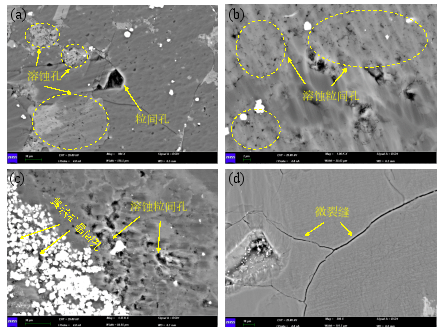
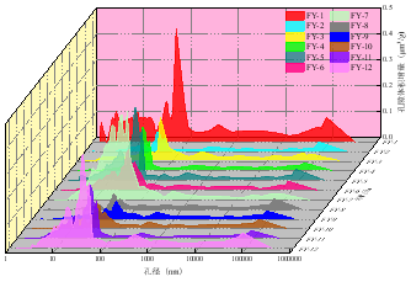
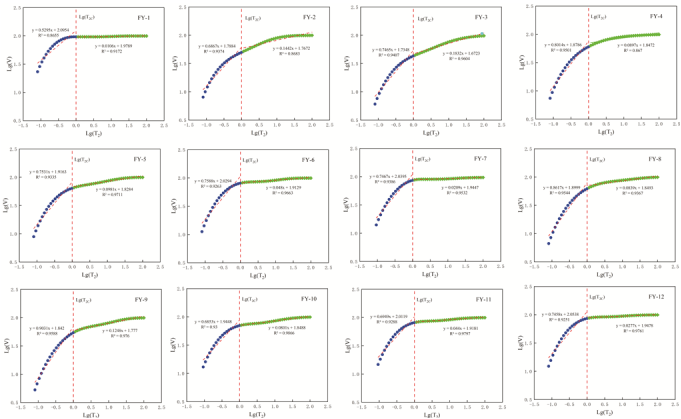
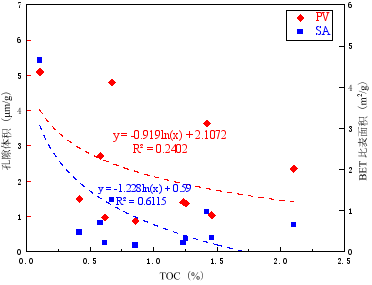
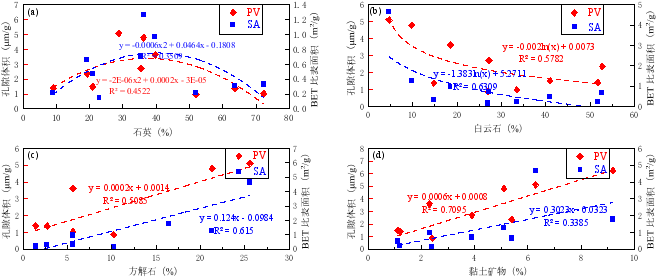
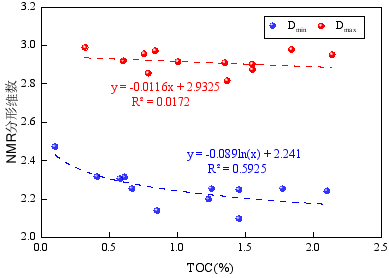
In recent years, significant breakthroughs have been achieved in the exploration of lacustrine shale oil in China, with mixed sedimentary shale oil in saline–alkaline lakes demonstrating substantial resource potential. This study focuses on the shale of the Fengcheng Formation in the Mahu Sag, Junggar Basin. By integrating field-emission scanning electron microscopy (FE-SEM), low-temperature nitrogen adsorption (LTNA), mercury intrusion capillary pressure (MICP), and low-field nuclear magnetic resonance (NMR), the pore structure and fractal characteristics of the shale were systematically characterized both qualitatively and quantitatively. The results indicate that inorganic pores dominate in lacustrine shale, including interparticle pores, intraparticle pores, intercrystalline pores, and microfractures, with pores in the II-micropore range (10–100 nm) contributing most significantly. The fractal dimension Dmax (2.9204) exceeds Dmin (2.2572), suggesting that the structural complexity of the pore system is greater than its surface roughness. Quartz exerts a dual influence on pore development, while higher calcite content is conducive to pore formation. In contrast, the cementation effect of dolomite may limit its positive contribution to porosity. Additionally, the relatively well-developed fractures in alkaline lacustrine shale facilitate the formation of complex fracture network systems, which are of critical importance for shale oil enrichment and reservoir stimulation.
| Published in | Science Discovery (Volume 14, Issue 2) |
| DOI | 10.11648/j.sd.20261402.13 |
| Page(s) | 35-43 |
| Creative Commons |
This is an Open Access article, distributed under the terms of the Creative Commons Attribution 4.0 International License (http://creativecommons.org/licenses/by/4.0/), which permits unrestricted use, distribution and reproduction in any medium or format, provided the original work is properly cited. |
| Copyright |
Copyright © The Author(s), 2026. Published by Science Publishing Group |
Shale Oil, Pore Structure, Fractal Dimension, Mahu Sag
| [1] | 周庆凡, 金之钧, 杨国丰, 等. 美国页岩油勘探开发现状与前景展望 [J]. 石油与天然气地质, 2019, 40(3): 469-477. |
| [2] | 马永生, 蔡勋育, 赵培荣, 等. 中国陆相页岩油地质特征与勘探实践 [J]. 地质学报, 2022, 96(1): 155-171. |
| [3] | 贾承造, 郑民, 张永峰. 中国非常规油气资源与勘探开发前景 [J]. 石油勘探与开发, 2012, 39(2): 129-136. |
| [4] | 赵文智, 胡素云, 侯连华, 等. 中国陆相页岩油类型、资源潜力及与致密油的边界 [J]. 石油勘探与开发, 2020, 47(1): 1-10. |
| [5] | 何文渊, 何海清, 王玉华, 等. 川东北地区平安1井侏罗系凉高山组页岩油重大突破及意义 [J]. 中国石油勘探, 2022, 27(1): 40-49. |
| [6] | 金之钧, 王冠平, 刘光祥, 等. 中国陆相页岩油研究进展与关键科学问题 [J]. 石油学报, 2021, 42(7): 821-835. |
| [7] | 贾承造, 王祖纲, 姜林, 等. 中国页岩油勘探开发研究进展与科学技术问题 [J]. 世界石油工业, 2024, 31(4): 1-11+13. |
| [8] | 支东明, 宋永, 何文军, 等. 准噶尔盆地中—下二叠统页岩油地质特征、资源潜力及勘探方向 [J]. 新疆石油地质, 2019, 40(4): 389-401. |
| [9] | Zhang Y, Jiang Z, Chang J, et al. Mobility evaluation of continental shale oil of the Permian Fengcheng Formation in the Mahu Sag: Reservoirs characteristics, multiple influencing factors and conceptual models [J]. Petroleum Science, 2025, 22(12): 4910-4930. |
| [10] |
张佳琦, 赵靖舟, 曹磊, 等. 鄂尔多斯盆地三叠系延长组长8-长9油层组泥页岩储层孔隙和微裂缝发育特征与页岩油勘探前景 [J]. 石油与天然气地质, 2025, 46(5): 1554-1581.
https://doi.org//10. 11743/ogg20250511 |
| [11] | 张原豪, 姜振学, 张成举, 等. 基于SEM-Maps技术的页岩多尺度有机-无机孔-缝结构特征定量评价——以川东北侏罗系凉高山组为例 [J]. 石油与天然气地质, 2026, 47(2): 522-536. |
| [12] | 朱炎铭, 王阳, 陈尚斌, 等. 页岩储层孔隙结构多尺度定性-定量综合表征: 以上扬子海相龙马溪组为例 [J]. 地学前缘, 2016, 23(1): 154-163. |
| [13] | 孙亮, 王晓琦, 金旭, 等. 微纳米孔隙空间三维表征与连通性定量分析 [J]. 石油勘探与开发, 2016, 43(3): 490-498. |
| [14] | Yang F, Ning Z, Liu H. Fractal characteristics of shales from a shale gas reservoir in the Sichuan Basin, China. Fuel, 2014, 115, 378-384. |
| [15] | Lai J, Wang S, Wang G, et al. Pore structure and fractal characteristics of Ordovician Majiagou carbonate reservoirs in Ordos Basin, China. AAPG Bulletin. 2019, 103, 2573-2596. |
| [16] | Zhang Y, Jiang Z, Chang J, et al. Multi-Scale Pore System and Its Implication for Shale Oil Occurrence in Alkaline Lacustrine Mixed Sedimentary Shale Reservoirs: A Case Study from Fengcheng Formation, Mahu Sag, Junggar Basin [J]. Journal of Earth Science, 2026, 37(1): 180-198. |
| [17] | Zhang P, Lu S, Li J, et al. Petrophysical characterization of oil-bearing shales by low-field nuclear magnetic resonance (NMR). Marine and Petroleum Geology. 2018, 89, 775-785. |
| [18] | Chang J, Fan X, Jiang Z, et al. Differential impact of clay minerals and organic matter on pore structure and its fractal characteristics of marine and continental shales in China [J]. Applied Clay Science, 2022, 216: 106334. |
| [19] | Zhang Z, Weller A. Fractal dimension of pore-space geometry of an Eocene sandstone formation. Geophysics. 2014, 79, D377-D387. |
| [20] | Zhang G, Hirasaki G, House W. Internal field gradients in porous media. Petrophysics-The SPWLA Journal of Formation Evaluation and Reservoir Description. 2003, 44. |
| [21] | Sun W, Zuo Y, Wu Z, et al. Fractal analysis of pores and the pore structure of the Lower Cambrian Niutitang shale in northern Guizhou province: Investigations using NMR, SEM and image analyses [J]. Marine and Petroleum Geology, 2019, 99: 416-428. |
| [22] | Bu H, Ju Y, Tan J, et al. Fractal characteristics of pores in non-marine shales from the Huainan coalfield, eastern China [J]. Journal of Natural Gas Science and Engineering, 2015, 24: 166-177. |
| [23] | Ross D J K, Bustin R M. The importance of shale composition and pore structure upon gas storage potential of shale gas reservoirs [J]. Marine and petroleum Geology, 2009, 26(6): 916-927. |
| [24] | Du X, Song X, Zhang M, et al. Shale gas potential of the Lower Permian Gufeng Formation in the western area of the Lower Yangtze Platform, China [J]. Marine and Petroleum Geology, 2015, 67: 526-543. |
| [25] | Chalmers G R L, Bustin R M. Lower Cretaceous gas shales in northeastern British Columbia, Part I: geological controls on methane sorption capacity [J]. Bulletin of Canadian petroleum geology, 2008, 56(1): 1-21. |
APA Style
Zhang, Y., Jiang, Z. (2026). Pore Structure Characteristics and Main Controlling Factors of Lacustrine Hybrid Shale of China: A Case Study of the Fengcheng Formation in the Mahu Sag. Science Discovery, 14(2), 35-43. https://doi.org/10.11648/j.sd.20261402.13
ACS Style
Zhang, Y.; Jiang, Z. Pore Structure Characteristics and Main Controlling Factors of Lacustrine Hybrid Shale of China: A Case Study of the Fengcheng Formation in the Mahu Sag. Sci. Discov. 2026, 14(2), 35-43. doi: 10.11648/j.sd.20261402.13
@article{10.11648/j.sd.20261402.13,
  author = {Yuanhao Zhang and Zhenxue Jiang},
  title = {Pore Structure Characteristics and Main Controlling Factors of Lacustrine Hybrid Shale of China: A Case Study of the Fengcheng Formation in the Mahu Sag},
  journal = {Science Discovery},
  volume = {14},
  number = {2},
  pages = {35-43},
  doi = {10.11648/j.sd.20261402.13},
  url = {https://doi.org/10.11648/j.sd.20261402.13},
  eprint = {https://article.sciencepublishinggroup.com/pdf/10.11648.j.sd.20261402.13},
  abstract = {In recent years, significant breakthroughs have been achieved in the exploration of lacustrine shale oil in China, with mixed sedimentary shale oil in saline–alkaline lakes demonstrating substantial resource potential. This study focuses on the shale of the Fengcheng Formation in the Mahu Sag, Junggar Basin. By integrating field-emission scanning electron microscopy (FE-SEM), low-temperature nitrogen adsorption (LTNA), mercury intrusion capillary pressure (MICP), and low-field nuclear magnetic resonance (NMR), the pore structure and fractal characteristics of the shale were systematically characterized both qualitatively and quantitatively. The results indicate that inorganic pores dominate in lacustrine shale, including interparticle pores, intraparticle pores, intercrystalline pores, and microfractures, with pores in the II-micropore range (10–100 nm) contributing most significantly. The fractal dimension Dmax (2.9204) exceeds Dmin (2.2572), suggesting that the structural complexity of the pore system is greater than its surface roughness. Quartz exerts a dual influence on pore development, while higher calcite content is conducive to pore formation. In contrast, the cementation effect of dolomite may limit its positive contribution to porosity. Additionally, the relatively well-developed fractures in alkaline lacustrine shale facilitate the formation of complex fracture network systems, which are of critical importance for shale oil enrichment and reservoir stimulation.},
 year = {2026}
}
TY  - JOUR
T1  - Pore Structure Characteristics and Main Controlling Factors of Lacustrine Hybrid Shale of China: A Case Study of the Fengcheng Formation in the Mahu Sag
AU  - Yuanhao Zhang
AU  - Zhenxue Jiang
Y1  - 2026/04/30
PY  - 2026
N1  - https://doi.org/10.11648/j.sd.20261402.13
DO  - 10.11648/j.sd.20261402.13
T2  - Science Discovery
JF  - Science Discovery
JO  - Science Discovery
SP  - 35
EP  - 43
PB  - Science Publishing Group
SN  - 2331-0650
UR  - https://doi.org/10.11648/j.sd.20261402.13
AB  - In recent years, significant breakthroughs have been achieved in the exploration of lacustrine shale oil in China, with mixed sedimentary shale oil in saline–alkaline lakes demonstrating substantial resource potential. This study focuses on the shale of the Fengcheng Formation in the Mahu Sag, Junggar Basin. By integrating field-emission scanning electron microscopy (FE-SEM), low-temperature nitrogen adsorption (LTNA), mercury intrusion capillary pressure (MICP), and low-field nuclear magnetic resonance (NMR), the pore structure and fractal characteristics of the shale were systematically characterized both qualitatively and quantitatively. The results indicate that inorganic pores dominate in lacustrine shale, including interparticle pores, intraparticle pores, intercrystalline pores, and microfractures, with pores in the II-micropore range (10–100 nm) contributing most significantly. The fractal dimension Dmax (2.9204) exceeds Dmin (2.2572), suggesting that the structural complexity of the pore system is greater than its surface roughness. Quartz exerts a dual influence on pore development, while higher calcite content is conducive to pore formation. In contrast, the cementation effect of dolomite may limit its positive contribution to porosity. Additionally, the relatively well-developed fractures in alkaline lacustrine shale facilitate the formation of complex fracture network systems, which are of critical importance for shale oil enrichment and reservoir stimulation.
VL  - 14
IS  - 2
ER  -
State Key Laboratory of Petroleum Resources and Engineering, China University of Petroleum (Beijing), Beijing, China; College of Geosciences, China University of Petroleum (Beijing), Beijing, China
State Key Laboratory of Petroleum Resources and Engineering, China University of Petroleum (Beijing), Beijing, China

Information



 Share This Article
 Twitter
 Linked In
 Facebook
 Copy
Copy Download